
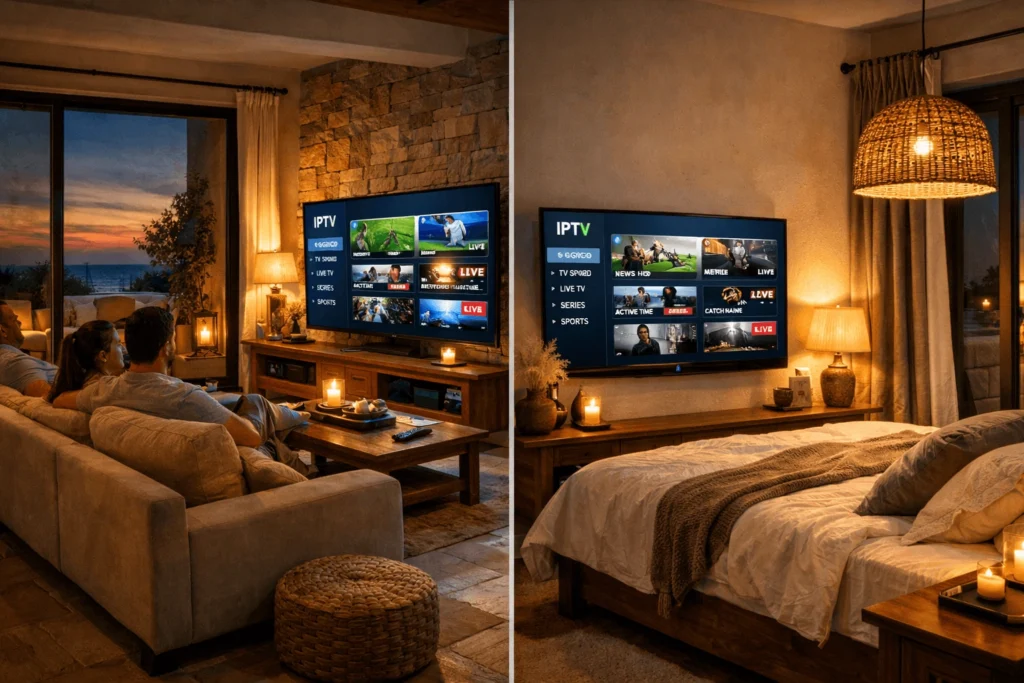
Modern households in Cyprus increasingly rely on IPTV as their primary source of television entertainment. A family with teenagers, a home office, and a living room television all active at the same time faces a practical question that subscription pages rarely answer clearly: how many screens can realistically stream IPTV at the same moment without buffering, disconnections, or account errors? The answer depends on a combination of factors — the subscription itself, the available internet bandwidth, the quality of the home network, and the devices in use. Understanding each of those variables separately is the most useful way to approach multi-room IPTV in Cyprus.
Multi-room IPTV refers to the ability to watch different IPTV channels or on-demand content simultaneously on more than one screen within the same household, each stream being independent of the others. This is distinct from screen mirroring or casting the same content to multiple displays. In a genuine multi-room setup, one family member might be watching a sports channel in the living room while another watches a film in a bedroom and a third follows a news channel on a tablet.
Each of those streams is a separate active session, and each one places its own individual demand on both the IPTV subscription account and the home internet connection. That distinction is important because it means the capacity limits come from two different sources at once.
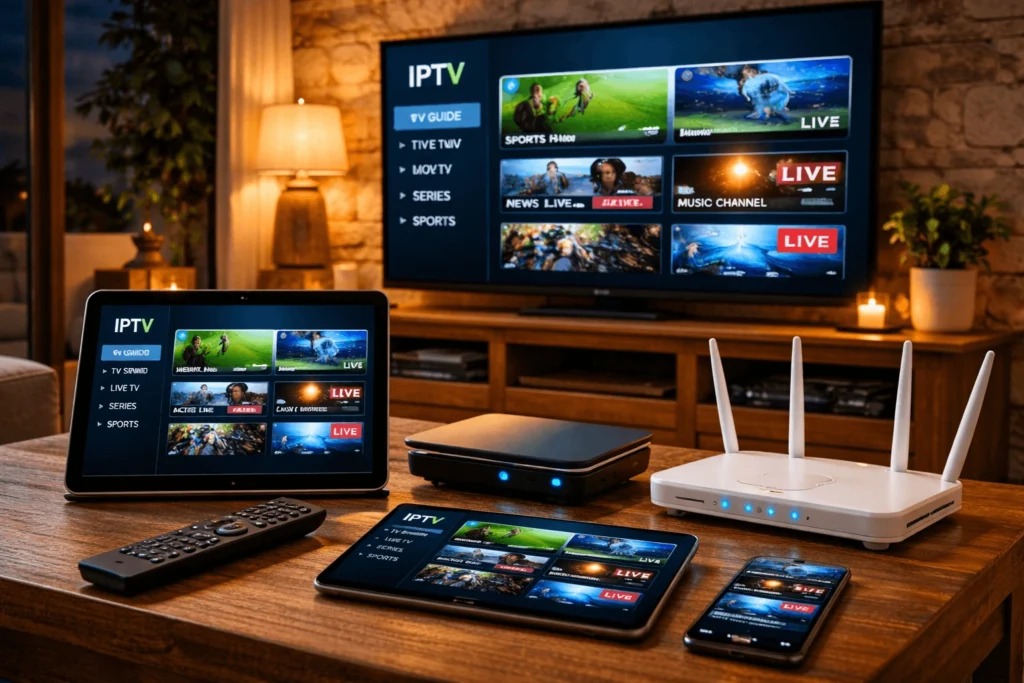
Every IPTV subscription is configured by the provider to allow a specific number of concurrent connections. This limit is enforced at the server level, meaning the provider’s infrastructure tracks how many active sessions are associated with a given account at any point in time. When the limit is reached, any additional device attempting to connect may be refused, shown an error message, or placed in a buffering loop with no clear explanation.
Entry-level IPTV subscriptions commonly allow only one simultaneous connection. Mid-tier packages often extend this to two or three. Higher-tier plans may offer more, though the specific terms vary between providers. Users searching for an iptv subscription Cyprus households can share across multiple rooms should look carefully at whether the plan they are considering explicitly states the number of permitted concurrent streams, rather than assuming a default.
It is worth noting that some users attempt to work around connection limits by sharing account credentials across more devices than the subscription allows. Beyond the terms of service implications, this approach typically results in unstable service, as the provider’s system may terminate sessions unpredictably when it detects excess connections.
Internet speed becomes a compounding factor as more screens stream simultaneously. A single HD stream typically requires a stable 10 Mbps connection. A single genuine 4K stream may require 25 Mbps or more depending on the codec used. Multiply those requirements by the number of active streams in a household and the minimum bandwidth needed scales accordingly.
A Cyprus household with three simultaneous HD streams needs a sustained download speed of at least 30 Mbps available for IPTV alone, with additional headroom for other connected devices. Households on fibre plans from providers such as Cyta, Cablenet, or PrimeTel in urban areas are generally well positioned for this, provided the plan tier they have subscribed to delivers those speeds reliably in practice. However, it is the real-world throughput — not the advertised maximum — that determines whether multi-room IPTV Cyprus setups perform without interruption.
Network congestion at peak hours, typically weekday evenings and weekend afternoons, can reduce effective bandwidth even on plans that handle multiple streams comfortably at other times. ISP routing paths between the user’s connection and the IPTV provider’s servers also affect latency and packet stability, which matter for live channel streaming more than they do for on-demand video.

The variety of devices used to access IPTV across different rooms in Cyprus homes is considerable. Smart TVs in main living areas, Android TV boxes connected to bedroom screens, tablets used by younger family members, and smartphones used on the go all represent potential simultaneous connections to the same account.
Android TV boxes are among the most commonly used devices for IPTV in Cyprus outside of smart TVs, and they vary significantly in processing power, codec support, and network connectivity. A box connected to the router via an Ethernet cable will generally deliver more stable streaming than one relying on a 2.4 GHz Wi-Fi signal from across the house.
IPTV Smarters Pro is one of the most widely installed applications for managing IPTV streams on both Android TV boxes and smart TVs. It supports multiple playlists and profiles, which makes it practical for households managing access across several rooms. When IPTV Smarters Pro is installed on multiple devices within the same account, each active session counts toward the connection limit set by the provider, so users need to be aware that opening the application and beginning playback on a third device while two others are already active may trigger an error if the subscription only permits two concurrent streams.
The home network itself is frequently the weakest link in a multi-room IPTV setup. A router positioned centrally in a flat or small house may provide adequate coverage for all rooms, but a larger property with thick concrete walls — common in many Cypriot residential buildings — can experience significant signal degradation at distance.
For reliable multi-room IPTV Cyprus households should consider using Ethernet connections for devices that remain stationary, such as an IPTV box in a living room or bedroom. Where wired connections are not practical, a mesh Wi-Fi system or a Wi-Fi extender with a dedicated backhaul can substantially improve the consistency of the wireless signal reaching secondary rooms.
Router placement matters considerably. A router tucked behind furniture or inside a cupboard will distribute signal less effectively than one positioned in an open, central location. Some routers also allow QoS, or Quality of Service settings, which let users prioritise IPTV traffic over other network activity during peak household usage.
Several recurring mistakes lead to poor multi-room IPTV performance. Using the same account on more devices than the subscription permits is the most common, followed by relying entirely on Wi-Fi for devices that could be connected by cable. Using outdated applications that do not support modern video codecs efficiently can also introduce playback problems that appear to be bandwidth-related but are actually device-side processing issues.
Another frequent oversight is failing to close IPTV sessions on devices that are no longer in active use. Some applications do not automatically terminate a session when the screen is turned off or the app is backgrounded, which means a connection slot may remain occupied on the provider’s server even when no one is actively watching.
For households in Cyprus looking to understand their current IPTV setup or explore options for multi-screen use, the service overview at iptvcyprus4k.com provides relevant context about available plans and device compatibility in the local market.
For questions about electronic communications standards, consumer rights relating to internet services, and broadband quality in Cyprus, the Office of the Commissioner of Electronic Communications and Postal Regulations publishes guidance and regulatory information at ocecpr.org.cy.
As IPTV usage in Cyprus continues to grow and households become more device-dense, the demand for flexible multi-connection subscriptions will increase. Providers are responding by offering more granular plan structures, and improvements in compression technology are making it progressively less bandwidth-intensive to support multiple simultaneous HD and 4K streams. For users today, the most reliable path to a stable multi-room IPTV experience is a clear understanding of what their subscription permits, what their connection can sustain, and how their home network is configured to deliver that capacity to every room.
Reliable IPTV service in Cyprus. Enjoy live TV, movies, and series with high-quality streaming, premium channels, and fast customer support.
© 2026 IPTV Cyprus. All rights reserved.
WhatsApp us