
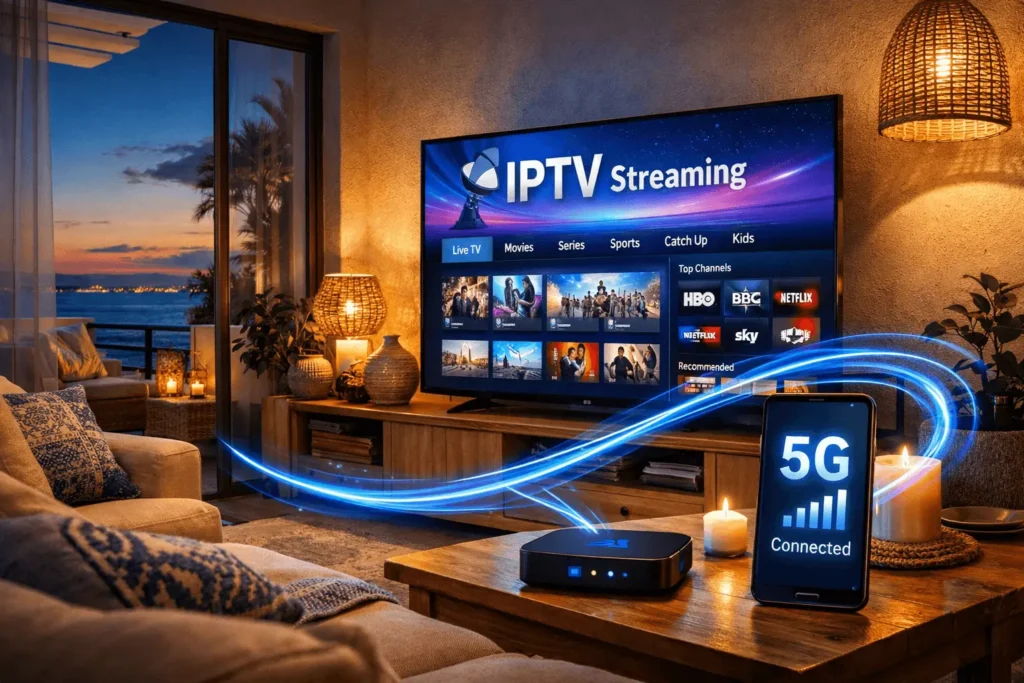
The way people in Cyprus consume television content has changed considerably over the past decade. Satellite dishes and cable subscriptions are giving way to internet-based streaming services, and IPTV in particular has become a popular choice for viewers who want access to live sports, international channels, and on-demand films without the constraints of a traditional broadcast package. As 5G mobile networks begin to roll out across the island, a natural question is emerging among tech-savvy users and households alike: could mobile internet eventually replace a fixed home broadband connection for everyday IPTV streaming? This article examines that question from a practical and technical standpoint.
5G is the fifth generation of mobile network technology, succeeding the 4G LTE standard that currently serves most mobile users in Cyprus. The fundamental difference between 5G and earlier mobile generations lies in three areas: speed, latency, and network capacity.
In ideal conditions, 5G can deliver download speeds exceeding 1 Gbps, which surpasses the real-world performance of many fixed broadband connections. More relevant to everyday use is the improvement in latency, which refers to the delay between a request being sent and data beginning to arrive. 5G networks can achieve latency figures of under 10 milliseconds, compared to 30 to 50 milliseconds that is typical of 4G, and sometimes higher on congested ADSL lines from providers such as Cyta or Cablenet.
For IPTV streaming, low latency and consistent throughput matter considerably more than raw peak speed. Traditional fibre broadband delivers those qualities reliably in a fixed home environment. Whether 5G can match that consistency in a residential context is the central question this article addresses.
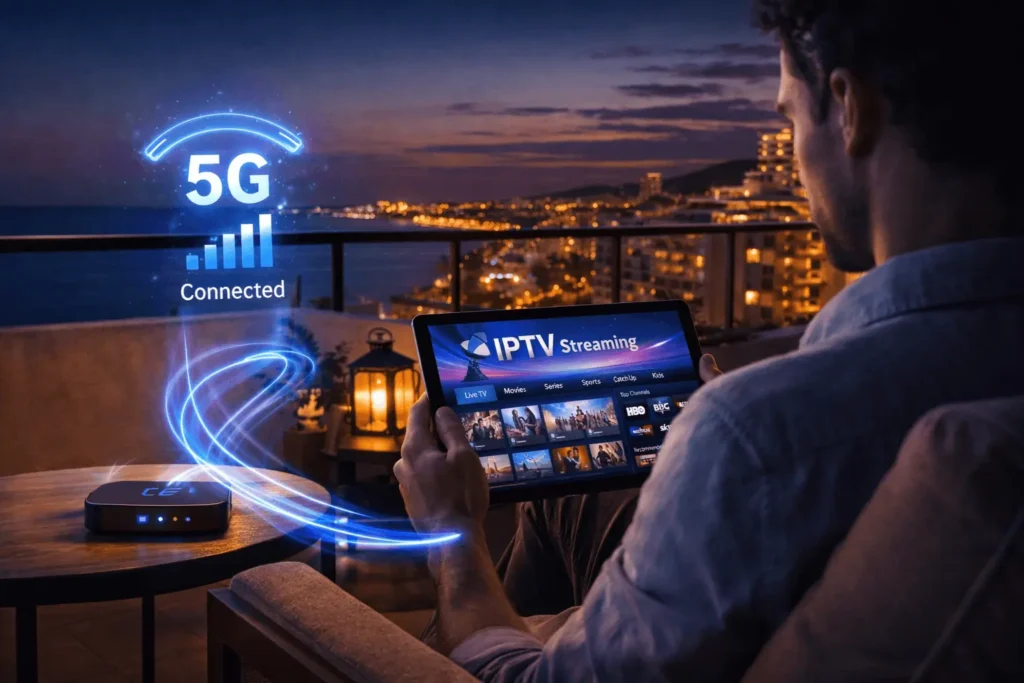
IPTV delivers video content as a continuous data stream over an internet connection. The stream must arrive at the player consistently and without significant interruption for the picture to remain stable. Applications such as IPTV Smarters Pro, which is widely used among IPTV Cyprus viewers, manage this process by buffering a small amount of content ahead of playback, creating a short reserve that absorbs minor fluctuations in connection speed.
When a mobile internet connection is used instead of fixed broadband, the same process applies. The IPTV player does not distinguish between a fibre connection and a 5G signal, provided the data arrives at the required rate. The practical challenge is that mobile connections introduce variables that fixed lines do not, including signal strength variation, network congestion, and handover events as a device moves between coverage cells.
To put the 5G question into context, it helps to understand the bandwidth requirements for different IPTV stream qualities. Standard definition content generally requires 4 to 6 Mbps, HD at 720p needs around 8 to 10 Mbps, and full HD at 1080p requires a stable 15 Mbps or above. 4K streams, where supported by an IPTV subscription Cyprus service, typically demand 25 Mbps or more with consistent delivery.
On paper, 5G comfortably exceeds all of these thresholds. The practical question is whether it delivers those speeds consistently in a given location, at a given time of day, without interruption. That consistency is what separates a good IPTV experience from a frustrating one, and it is where the comparison between IPTV 5G Cyprus and fixed broadband becomes more nuanced.
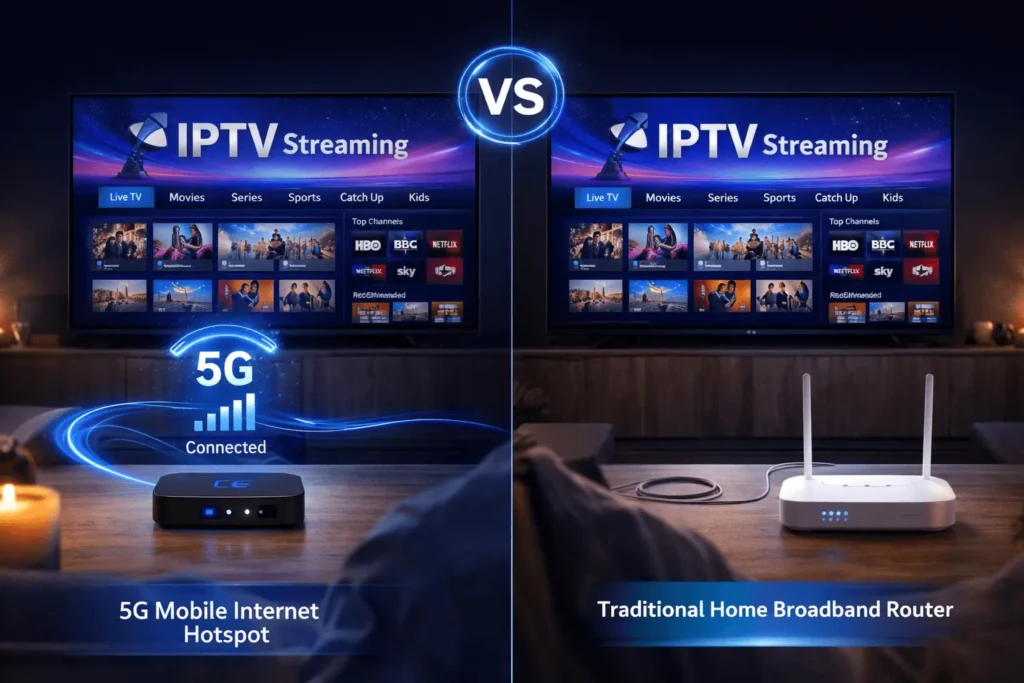
The most obvious advantage of 5G for IPTV is its speed potential. In areas with strong 5G coverage, the available bandwidth exceeds what most IPTV streams require by a considerable margin, providing a comfortable headroom that reduces the risk of buffering even during high-demand periods.
5G also offers a practical solution for households in parts of Cyprus where fixed broadband infrastructure remains limited. Rural areas and some coastal or hillside locations have historically had poor access to fibre services, and ADSL connections in these areas often struggle to deliver the consistent speeds that HD IPTV requires. For residents in these locations, a 5G home router represents a potentially transformative upgrade.
The installation simplicity of 5G home broadband is another meaningful advantage. A 5G router requires no physical cabling to the street or telephone exchange, meaning that setup can be completed in minutes rather than waiting for an engineer visit or infrastructure upgrade.
Despite its impressive headline figures, 5G has real limitations that affect its suitability as a primary home broadband replacement for IPTV streaming. Coverage remains uneven across Cyprus, and the highest 5G speeds are currently concentrated in urban centres. Outside Nicosia, Limassol, and Larnaca, coverage thins considerably, and in many residential areas only 4G or 4G+ signals are available.
Even within covered areas, 5G signal penetration into buildings can be inconsistent. The higher frequency bands used by some 5G deployments do not pass through walls as effectively as lower frequency signals, meaning that a strong outdoor 5G signal does not always translate into reliable indoor performance.
Data caps represent another significant constraint. Most mobile data plans in Cyprus, even generous ones, impose monthly data limits that a household using IPTV as its primary television source would exhaust quickly. Watching HD IPTV content consumes approximately 3 GB per hour. A household watching four hours of television daily would use around 360 GB per month on HD content alone, a figure that exceeds the limits of many mobile plans and would incur additional charges or speed throttling beyond the cap.
The rollout of IPTV 5G Cyprus infrastructure is ongoing, with the major mobile operators progressively expanding their coverage footprints. Urban areas across the island have seen the most investment to date, and performance in well-covered city locations can genuinely rival fixed broadband for streaming purposes. The Office of the Commissioner of Electronic Communications and Postal Regulation (OCECPR), which oversees telecommunications standards and market regulation in Cyprus, publishes information on network coverage and consumer rights that users can refer to when assessing mobile broadband options in their area.
For viewers in suburban or rural locations, the realistic picture is more mixed. 5G availability in these areas will improve over time, but at present many users remain dependent on 4G connections with the limitations that entails for consistent high-definition streaming.
Any household seriously considering replacing home broadband with 5G for IPTV purposes needs to assess data usage carefully. As noted above, HD streaming is data-intensive, and 4K content is more so. Users who regularly watch live sports, films, or lengthy series through an IPTV service will accumulate data consumption that most standard mobile plans are not designed to accommodate.
Some operators offer unlimited or very high cap plans specifically targeting home broadband replacement customers, and these are the plans worth evaluating if 5G is to serve as a serious IPTV 5G Cyprus solution. Comparing the true cost of such a plan against a standard fibre broadband subscription is an important step before making the switch.
For users who are already using or considering 5G for IPTV, several practical steps improve streaming stability. Placing a 5G home router near a window on the side of the property facing the nearest cell tower improves signal reception. Connecting IPTV devices such as a Smart TV or IPTV box Cyprus to the router via Ethernet rather than WiFi eliminates the additional variable of in-home wireless performance.
Within IPTV Smarters Pro and similar applications, adjusting the buffer size to a higher setting provides a larger reserve of pre-loaded content that absorbs brief signal fluctuations. Choosing SD or HD streams rather than 4K reduces bandwidth demand and lowers data consumption simultaneously, extending the usable life of a monthly data allowance.
Further guidance on compatible IPTV players, device configurations, and subscription options for Cyprus viewers is available at https://iptvcyprus4k.com/.
The honest answer to whether IPTV 5G Cyprus can fully replace home broadband is: it depends, and for many households, not yet. In urban areas with strong, consistent 5G coverage and an unlimited data plan, 5G is a credible alternative to fixed broadband for IPTV streaming. The speeds are sufficient, the latency is acceptable, and the flexibility is genuine.
For households outside well-covered urban areas, those on capped mobile plans, or those who watch several hours of television daily, fixed broadband remains the more reliable and cost-effective foundation for IPTV. The technology gap between 5G and fibre is narrowing, and as Cyprus’s 5G infrastructure matures, the case for mobile-first home streaming will strengthen. For now, the wisest approach is to evaluate your specific location, data needs, and available plans before treating 5G as a complete replacement rather than a useful complement to existing connectivity.
Reliable IPTV service in Cyprus. Enjoy live TV, movies, and series with high-quality streaming, premium channels, and fast customer support.
© 2026 IPTV Cyprus. All rights reserved.
WhatsApp us